Library Past events

San Francisco 14–15 March 2026 Conference

Funding the Commons SF 2026: Intelligence at the Frontier

A 36-hour festival, conference, and hackathon across 16 floors of Frontier Tower, co-designing the coordination infrastructure for human flourishing.

145 sessions · 155 speakers · 36 recordings · Frontier Tower, San Francisco

Talks and speakers
who took the stage, and on what

145 sessions

Day
Where
Format

Saturday 14 March 2026

Hackathon Opening Session

Sabeen Ali Global Head of Developer GTM & Programs, Protocol LabsTereza Bízková Funding the CommonsDevinder Sodhi Learning Layer Labs

Panel · Floor 2 (Funding the Commons)

Description

Three floors. Four tracks. 36 hours to build something that matters. The hackathon opening kicks off the build across Physical AI & Robotics, Agentic Finance, Sovereign Infrastructure, AI Safety & Evaluation, and Neurotech & BCI. Track leads and sponsors will introduce the challenges, walk through available tooling and compute, and answer questions before teams form. If you're here to ship, this is where it starts.

Opening Words

David Casey CEO, Funding the Commons

Talk · Floor 2 (Funding the Commons)

Description

The decisions being made right now about how AI systems are built, governed, and funded will compound for decades. Most of the people making those decisions are in separate rooms with separate vocabularies and separate assumptions about what the problem actually is. This event is an attempt to fix that, for two days, in one building, across sixteen floors. David Casey, CEO of Funding the Commons, opens the festival and lays out why the infrastructure question is the one worth obsessing over.

Welcome from Frontier Tower’s Founder

Jakob Drzazga Frontier Tower

Talk · Floor 2 (Funding the Commons)

Description

Frontier Tower was designed as a vertical home for the builders, founders and teams building what comes next. Jakob, co-founder of Frontier Tower, opens with a simple premise: the physical environment where people work shapes what they build and who they build it with. He'll talk about what it took to create a home for frontier technology in San Francisco, and why this city, this building, and this moment are more connected than they might seem.

Incentivizing Energy Abundance (Talk)

Vik Kalghatgi Chief Scientist & Head of Research, Kashi

Floor 9 (AI & Autonomous Systems)

Description

Scaling clean energy infrastructure becomes possible when incentives reward the right outcomes, people coordinate effectively around shared objectives, and capital is efficiently allocated. Glow is a crypto protocol built on this premise, applying a Bitcoin-inspired token emissions and competition model to solar deployment. Instead of miners competing to produce hash power, solar farms compete to generate impactful clean energy, creating a positive-sum incentive network tied to real-world infrastructure. This talk will cover the theory behind Glow’s incentive design, how Glow is scaling new solar installations across the US and globally, and ultimately how programmable incentive networks can unlock an abundant energy future for humanity.

Floor Invitations & Governance Experiment Results

David Casey CEO, Funding the CommonsJudy Zhou Ecosystem Advisor, Frontier Tower

Panel · 05: Applied AI: Real Deployments · Floor 2 (Funding the Commons)

Description

Intelligence at the Frontier isn't a single conference - it's a 16-floor festival, and each floor runs its own experiment. Before the weekend began, every floor lead received a budget and full authority to decide how to use it. No central committee, no top-down programming. This session is the reveal: floor leads take three minutes each to share what's happening on their floor and how they chose to govern the money. Part festival guide, part live case study in decentralized decision-making.

Welcome & Ethereum House Orientation

Yoofi Annan

Floor 12 (Ethereum & Decentralized Tech)

Description

Come learn what will be happening on Floor 12 throughout the weekend from Yoofi Annan, Community Director of Ethereum & Decentralized Tech at Frontier Tower.

[Panel] Open Source Observer

Panel · Floor 12 (Ethereum & Decentralized Tech)

Emcee Introduction & Orientation

Tricia Wang CEO, Advanced AI Society; Co-founder, Sudden Compass

Floor 2 (Funding the Commons)

Governing the Commons in the Intelligent Age

David Dao GainForest

Keynote · 04: Open AI Infrastructure · Floor 2 (Funding the Commons)

Description

Most AI development optimizes for speed, scale, and profit. David Dao has been building in a different direction: applying machine learning to rainforest conservation, impact verification, and ecological data systems that communities actually control. In this talk, he asks what it would mean to train intelligence on what we want to sustain rather than what we want to extract, and what that shift requires from the people designing these systems.

Sovereign Infrastructure: Lessons from Web 0 to Web 3

Shai Perednik Independent Principal Solutions Architect & Fractional CPTO, Perednik LLC

Floor 9 (AI & Autonomous Systems)

Description

A rapid, opinionated journey through what sovereignty has meant at each era of the web — scored against four pillars: identity, compute, governance, and coordination. Each era promised independence. Each era delivered partial sovereignty while accidentally centralizing the connective tissue between layers. The talk names the pattern, diagnoses where we are today, and delivers a concrete "gap map" of the highest-leverage problems the Sovereign Infrastructure track should be attacking right now.

Immersive Theater Sense-Making

Jack Manning Bancroft AIME / IMAGI-NATIONCharley Hasenbeck Founder & Cultural Convenor, CIRCUL / Creative Culture Club

Floor 14 (Flourishing)

Shiftwave Sessions + Walk VR

AlanBen Simon-Thomas

Floor 14 (Flourishing)

Welcome to the Funders Floor

Talk · Floor 16 (d/acc Lounge)

Description

What funding systems do we need to support a safe, beneficial transition for humanity and what does it take to fund commons infrastructure in practice? Our sessions today address the full stack of capital allocation: from community and city treasuries, grants and philanthropy, fellowships and incubators, prizes and retroactive rewards, venture and blended finance, to real estate and place-based funding models.

The Intelligence Curse

Luke Drago Workshop Labs

Keynote · 02: The Intelligence Curse: Who Captures AI Value · Floor 2 (Funding the Commons)

Description

The resource curse describes a paradox economists have documented for decades: countries sitting on vast natural wealth often end up poorer, more corrupt, and less stable than their resource-poor neighbors. Luke Drago argues AI is following the same script. The surplus is real and accelerating, but the structures we have for distributing economic value were built for a different era. What happens when the most productive technology in history generates returns that existing systems can't redistribute? Luke makes the case that concentration isn't just an equity problem. It's a security one.

The state of Public Goods Funding + Web3

Talk · Floor 16 (d/acc Lounge)

Keynote: Kevin Owocki

Kevin Owocki founder, Gitcoin

Talk · Floor 16 (d/acc Lounge)

Opening Context: Human Alignment Before AI Alignment

Hank Holiday Meta Founder, Quorum1Judy Zhou Ecosystem Advisor, Frontier TowerMing Founder & Executive Director, Flourishing Systems Foundation

Talk · Floor 14 (Flourishing)

Description

As AI accelerates, we are entering a rare window for civilizational redesign. Technological disruption brings not only risk, but the opportunity to rethink how we work, govern, and care for one another.

The Acceleration of Dehumanization: AI Agents, Differential Friction, and the Rise of the Machine Majority

Keynote · 01: AI Governance & Trust · Floor 2 (Funding the Commons)

Description

As AI agents proliferate across digital systems — executing transactions, navigating bureaucracies, and representing interests at machine speed — they are quietly becoming the dominant class of participants in the digital economy. Sheila Warren calls this the rise of the machine majority, and argues it is producing a specific, structural form of dehumanization: not dramatic, but architectural. The mechanism she terms differential friction — AI agents increasingly encounter fewer procedural, cognitive, and social barriers than humans interacting with the same systems. As platforms optimize for machine interaction, human participation becomes slower, harder, and less legible by design. Warren's work has long centered on a core conviction: that the digital economy only functions justly when human beings retain voice, choice, and stake in the systems that govern them. From that vantage point, the machine majority isn't just a technical phenomenon — it's a governance failure in slow motion. This talk examines what it would take to design against it: building friction back in where it protects human agency, and rethinking what institutions, protocols, and infrastructure need to look like when the default participant is no longer human.

Algorithmic Ancestry: Digital Stewardship in the Shadow of Silicon Valley

Desi Danganan Executive Director, Kultivate Labs

Floor 9 (AI & Autonomous Systems)

Description

"Algorithmic Ancestry" explores SOMA Pilipinas navigating AI in Silicon Valley’s shadow. We’ll cover our history of tech displacement and how Kultivate Labs builds community resilience. We will unpack the realities of our OpenAI literacy program and the valid grassroots pushback. Finally, because Big Tech has historically ignored our traditional heritage, we’ll demo the custom AI apps I’ve built to revitalize pre-Philippine scripts like Baybayin, ensuring our culture shapes the digital future.

Funding mechanism diversity

Panel · Floor 16 (d/acc Lounge)

Description

Many funding mechanisms are available for public-interest and commons work, supporting different stages, incentives, and types of value creation. This panel offers a range of perspectives on the ecosystem, and invites everyone to ask “If you had to fund a major public-interest breakthrough tomorrow, what mechanism would you actually use, and why?”

Body Work

Patience Anaya

Other · Floor 14 (Flourishing)

Opening Circle: Human Alignment Before AI Alignment

Helen TsimRaman Fray Regen BridgeMelanie McDougall CEO, Mitra AIMax Song CarbonbasePatricia Mou

Roundtable · Floor 14 (Flourishing)

Description

Commons are the birthplaces of public goods. This opening panel brings together leaders in commons-building, governance, institutional design, and civic innovation to explore how real-world commons infrastructure can expand society’s capacity for experimentation, collective sense-making, and responsible innovation.

Designing the Institutional Infrastructure for AI: How Cities Become Innovation Ecosystems

Augusto Ardiles Diaz AI & Innovation, Ministerio de Desarrollo Económico, Buenos Aires City Government, Gobierno de la Ciudad de Buenos Aires

Talk · 05: Applied AI: Real Deployments · Floor 2 (Funding the Commons)

Description

The standard conversation about AI ecosystems focuses on two things: talent and capital. Buenos Aires is making the case for a third, underestimated factor — institutional infrastructure — and building it in real time. This talk presents Buenos Aires's approach to becoming an AI-ready city, built on a deliberate policy philosophy: do not penalize technological development; ensure accountability when harm occurs. That translates into concrete architecture: soft law frameworks and best-practice standards instead of premature hard regulation; regulatory sandboxes that let startups experiment under supervised conditions; a dedicated AI District in the city center designed to concentrate companies, researchers, universities, and investors in a single cluster with tax incentives attached; and governance institutions — an AI Advisory Council, a Strategic Board of AI companies, and an AI Ecosystem Observatory — that allow policy to evolve alongside the ecosystem rather than lag behind it. The broader argument is structural: in a world where AI capability moves faster than traditional institutions, cities are uniquely positioned to act as real-world laboratories. The ones that get the coordination layer right — connecting talent, capital, and institutional frameworks — will shape the next wave of innovation.

Immerisia

David StarfireSteven JP Comeau Partner, Immerisia

Floor 6 (Arts & Music)

Description

20 minute sessions every half hour: a multisensory installation where the participants will hear, see, and feel music. The project features a 360 degree 12-speaker surround sound system, LED matrix lighting, and a 12x12 ft vibroacoustic (subwoofer) bed. The lights create psychedelic patterns when eyes are closed. The experience can accommodate roughly a dozen people at a time. The experience is guided by original compositions created exclusively for this environment including a healing journey from David Starfire and ethereal cinematic soundscape composed by Steve Comeau.

Design Your Own Scent: Perfume 101

Elliot Roth Partner, Biopunk Community

Floor 8 (Neuro & Biotech)

Description

Learn the basics of perfumery, putting together something that evokes the true spirit of your identity within this community. You'll learn about scent families, how to test, measure and create something that leaves a lasting impression.

Investing in a Future Where Humans Have a Growing Stake

Panel · Floor 16 (d/acc Lounge)

Description

How do we invest in a commons that drives progress in ways that augment human capability and agency rather than simply displacing them with agents? What technological infrastructure should society be investing in right now that markets are ignoring?

From Metrics to Coordination: Engineering Systems for Human Flourishing in the Age of AI

Adeeb Valiulla Senior Director, Customer Architecture and AI Strategy, Harness

Floor 9 (AI & Autonomous Systems)

Description

As AI systems accelerate the pace of software development and decision-making, the limiting factor is no longer intelligence. It is coordination. Modern organizations already struggle with fragmented signals: disconnected metrics, misaligned incentives, and opaque workflows that prevent teams from acting on insight. As AI agents increasingly participate in development, decision loops, and operational systems, these coordination challenges will only intensify. This talk explores how engineering intelligence systems can serve as early prototypes for coordinating human and machine intelligence. Drawing on real implementations of engineering intelligence platforms used across large technology organizations, the session demonstrates how operational data from development workflows can be transformed into coordination signals that align teams, surface bottlenecks, and guide strategic decision-making. The talk will explore: • Why coordination failures, not intelligence scarcity, are the dominant constraint in modern organizations • How measurement systems shape incentives and institutional behavior • How engineering intelligence platforms convert operational telemetry into actionable coordination signals • Why AI governance must include transparent measurement and coordination infrastructure If intelligence becomes a new economic resource, then the systems that measure and coordinate intelligence will determine whether AI accelerates fragmentation or enables human flourishing. Engineering organizations are already experimenting with these systems today. The lessons from these experiments can help inform how we design the governance and coordination infrastructure for an AI-native world.

The Coordination Problem: How UNICEF Is Building Financial Rails for the Age of AI

Matthias Bronner Blockchain Consultant, UNICEF Office of Innovation

Talk · 03: AI-Assisted Decision Making · Floor 2 (Funding the Commons)

Description

The UN's humanitarian systems were built for a world where resources move slowly and accountability is retrofitted after the fact. Matthias Bronner advises UNICEF on a novel architecture: crypto-denominated investments, on-chain fund disbursement, and open-source tooling that makes aid flows auditable by design. The question he brings to this room is what happens to that infrastructure as AI accelerates everything around it. When intelligence becomes cheap and abundant, the bottleneck isn't generating value anymore, it's governing where it goes. The coordination rails being built now will determine whether AI surplus reaches the people who need it most or stops well short.

Human Flourishing in the Age of AI

Shady El Damaty CEO & Co-founder, Holonym Foundation (http://human.tech), human.tech

Keynote · 04: Open AI Infrastructure · Floor 2 (Funding the Commons)

Description

As AI systems become capable of passing every test we've designed to distinguish humans from machines, the question of what it actually means to be human online becomes urgent infrastructure rather than philosophy. Shady El Damaty, founder of Human.Tech, has been building the answer: privacy-preserving proof of personhood that lets people assert their humanity without surrendering their identity. In a world trending toward superintelligence, the ability to verify that a decision, a vote, or a claim comes from a real person may be one of the few remaining foundations of trust that matters.

Sketchboard Talk

Natalie Gavidia

Floor 6 (Arts & Music)

Description

Natalie

Exit to the Commons - Funding Catalytic Communities

Ferananda Ibarra Co-founder, social architect, RealGold and Real Assets FoundationTaj James Full Spectrum CapitalJeff Emmett MycoFiJoshua Prieto CEO, regenBEE / Seeds of TaoOliver ClarityPeter Schurman Global Commons FundStuart Cowan Buckminster Fuller Institute

Floor 14 (Flourishing)

Description

Venture capital has played a central role in funding technological innovation, yet most financial returns flow in one direction — from public goods into privately captured gains. This session addresses funding catalytic communities.

Co-Design Lab: Learning & Working in Post Labor Economy

Patrick Deegan TeddybotMax Song CarbonbaseSara OlsenNoah SoltClare Hedin Creative, Musician, Artist, Dynamic Emergence

Panel · Floor 14 (Flourishing)

Before You Build: Cultivating Wise Innovation from the Beginning

Andrew Dunn Vision Guide, School of Wise Innovation

Workshop · Floor 14 (Flourishing)

Description

When AI can create anything, the hard problems shift from technical and operational to cultural and relational. If you're starting something new and want to build differently this time, join an intimate and interactive workshop on setting the right foundations for flourishing. We'll reconnect with the initial spark of insight, integrate lessons from past projects, and explore the conditions for bringing vision to life in ways that are better for all touched. The intention of this session is to regenerate the inner and cultural commons around vision literacy, in service of developing a culture of wise innovation. All participants will receive a free physical copy of the Vision Guide, inspired by ongoing research at School of Wise Innovation: supporting founders and changemakers in living, working, and creating with greater alignment. If you miss the session but would like a digital copy of the guide, you can get it here: https://andrewdunn2.gumroad.com/l/vfycd

Interactive Funder Introductions

Workshop · Floor 16 (d/acc Lounge)

The Art of Livecoding - Music as Algorithm

Brandon Tai

Floor 6 (Arts & Music)

Description

The art of livecoding is a growing movement where artists compose and perform music entirely through code - in real time, with everything visible to the audience. In this session, Brandon Tai breaks down why algorithmic thinking unlocks a fundamentally new relationship with music, including a live demo in Strudel, building songs from scratch on stage. Brandon Tai is a researcher and livecoder based in San Francisco. He performs algorithmic music live for audiences ranging from corporate stages to livecode communities across the country.

Mapping AI for Science: The Landscape and What Lies Ahead

Marius Wiggert Staff AI Research Scientist, Biohub

Floor 9 (AI & Autonomous Systems)

Description

Scientific and technological progress underpins productivity and most of the life quality gains in the last centuries. AI is poised to dramatically accelerate that engine in a variety of ways. In this talk, I'll survey the key dimensions along which AI is accelerating scientific discovery: domain-specific foundation models that encode deep knowledge of biology, chemistry, and the physical world; multi-modal systems that reason across data types; practical tools reshaping everyday research workflows; and agentic systems that can autonomously hypothesize and experiment. For each, I'll map the different approaches being taken, what's working, and where the gaps remain. Grounded in my own work at the intersection of biology and AI — but spanning the broader sciences — I'll close with an outlook on where this field is headed, what's missing, and how we can ensure these capabilities serve as broadly shared public goods rather than concentrating in the hands of a few.

Agentic Marketplaces: Compute, Energy, and Information on Decentralized Rails

Levi Rybalov Founder and CEO, Arkhai

Floor 12 (Ethereum & Decentralized Tech)

New Capital Coordination: Founder Pools, SPVs, and Applied Innovation

Panel · Floor 16 (d/acc Lounge)

Description

Traditional venture capital concentrates decision-making power in a small number of firms and partners. At the same time, builders and communities increasingly want to coordinate capital collectively, whether through founder pools, SPVs, DAOs, or cooperative investment structures. This session explores emerging models that allow groups of founders, investors, and communities to deploy capital together, drawing from real-world experiments.

From Hackathon to Mainnet: Designing Builder Funnels That Actually Ship

Shai Perednik Independent Principal Solutions Architect & Fractional CPTO, Perednik LLC

Floor 9 (AI & Autonomous Systems)

Description

Your hackathon has 150–200 builders and a $10K+ prize pool. What happens on Day 16? Most hackathon projects die within a month. I share the exact builder graduation framework I built and ran at scale — Hackathon → Protocol Rewards → Accelerator → Seed Funding, with AI-powered evaluation scoring at every gate — then participants design a graduation funnel for their ecosystem or project.

The Body as Commons: Relational Intelligence Embodiment Workshop

Brigitte Wittmer Movement Alchemist & Embodied Leadership Coach, B-Moving

Workshop · Floor 14 (Flourishing)

Future of Work Co-Design Lab (Continued)

Patrick Deegan TeddybotMax Song CarbonbaseNoah SoltSara OlsenJames Win Founder, TalentOSClare Hedin Creative, Musician, Artist, Dynamic EmergenceMichael Herrera

Floor 14 (Flourishing)

Description

New forms of decentralized governance and coordination are needed to turn participation into meaningful decision-making and collective action—without reverting to rigid hierarchies.

Intro to Institutional Imagination Block & Engineering Democratic Systems

Liz Barry Executive Director, Metagov

Keynote · 01: AI Governance & Trust · Floor 2 (Funding the Commons)

Description

Most governance failures aren't failures of values - they're failures of imagination. We know what we don't want. We're less practiced at designing what comes next. Liz Barry, Executive Director of Metagov, has spent her career closing that gap: from facilitating large-scale public listening with Polis, to writing the first western coverage of Taiwan's vTaiwan democracy experiments, to building the interoperability standards that now govern $19B in on-chain value and power Scotland's national public engagement platform. This session is a working introduction to the tools and frameworks Metagov uses to prototype new governance architectures - for online communities, DAOs, and institutions that haven't been invented yet. If AI is going to reshape how decisions get made, the people in this room should have a hand in designing what replaces what breaks.

Integrating Real-time Generative AI Synthesis into Studio Production and Live Performances with Ashu and the Magenta Team

Floor 6 (Arts & Music)

Description

The Magenta project is a decade-long, open-source research project exploring machine learning as a tool in the creative process. We'll dive into real-time neural audio generation using Magenta RT (open-weights), The Infinite Crate open-source DAW plugin, and the Lyria RT API. We’ll learn to give models a distinct and authentic sonic character through finetuning and building custom interfaces that integrate into live sets and production workflows.

🎤 OPENING KEYNOTE — Deep Funding & Retrospective Impact —

Keynote · Floor 12 (Ethereum & Decentralized Tech)

Scaled Democratic Reasoning

Jamie Joyce President & Executive Director, The Society Library

Keynote · 03: AI-Assisted Decision Making · Floor 2 (Funding the Commons)

Description

Democratic systems were designed for a world where the bottleneck was getting people in the same room. Jamie Joyce, founder of The Society Library, has been rebuilding the underlying infrastructure for a world where the bottleneck is something harder: getting people to reason together across complexity, misinformation, and scale. Her work produces structured argument maps that model every meaningful perspective on contested issues, from nuclear energy to AI governance, creating what she calls "libraries of reasoning" that can inform legislators, citizens, and AI systems alike. In this talk she'll address what it actually takes to scale democratic reasoning rather than just democratic participation, and why that distinction may be the most important design choice we make before superintelligent systems start making decisions on our behalf.

Capital Mechanisms for Frontier Innovation

Judy Zhou Ecosystem Advisor, Frontier TowerKyle MorrisJeff Emmett MycoFiTaj James Full Spectrum CapitalFerananda Ibarra Co-founder, social architect, RealGold and Real Assets FoundationPhilip Chen

Floor 14 (Flourishing)

Description

ON FLOOR 16: This participatory lab convenes funders, founders, governance designers, and public-goods builders to prototype capital mechanisms that enable innovation communities to function as shared infrastructure.

Relational Commons: Building the Inner Commons

Megan ShabramNima ImaniChelsea Borruano Founder & CEO, InsightsOutHelen TsimJames Regan

Workshop · Floor 14 (Flourishing)

Description

The ability of communities to sense, interpret, and respond together becomes a critical form of infrastructure. This session focuses on shared relational practices for navigating complexity.

Coherence Calibration for Frontier Leaders

Sydney Campos 2x Best Selling Author, Strategic Advisor, 3x Founder, Capital Partner

Workshop · Floor 14 (Flourishing)

Description

This interactive immersion helps leaders reset and restore internal coherence — the foundation for clear thinking, resilient leadership, and sustainable performance. Through guided practices and conversation, participants will learn simple ways to bring more calm, clarity, and focus into their daily lives while connecting deeply with fellow leaders building at the frontier of innovation.

The Ecomimetic Governance Gameshow: Governing the Commons?! Coordination Without Control

Hank Holiday Meta Founder, Quorum1Nicole KlauTibet Sprague Director of Technology, Hylo / Terran CollectiveYev Muchnik Launch Legal LLCArt Brock HolochainAthena Aktipis Arizona State University, Cooperative Futures InstitutePeter Schurman Global Commons FundRüzgar Imski Cofounder, Playnet

Roundtable · 01: AI Governance & Trust · Floor 14 (Flourishing)

Description

What does governance look like without rigid hierarchical structures? How do we architect truly self-managing organizations? How can we bring the emergent creativity & resilience of living ecosystems into the structural cores of collective commons? ⏭️ NOTE: Also join us after for Part 2 on Floor 16 @ 3:30 if you can! “Commons Governance Co-Design Lab” ⏭️ We've got a circle of 8 experts from the cutting edge of collective governance structures. Together we'll be playing a game! Our contestants will be competing to be the first person to earn the prestigious title of “Governator of the Commons”. Our game will move through three commons governance challenge areas. We’ll surface innovative mechanisms & real world examples of future-ready governance structures, Along the way we’ll educate each other, expand our governance imaginations, and entertain the org structure geek in all of us. This will be a fast-paced and mildly chaotic game show formatted experience, with lots of audience participation. Come have fun with us!

Future of Work: Human-AI Teams

Patrick Deegan Teddybot

Talk · Floor 14 (Flourishing)

Description

Alignment stops being a checklist and becomes a capacity that must grow under real-world collaboration. PART 2: A shamanic orientation to AI

Co-Design Lab: Capital Mechanisms for Frontier Innovation Communities - From Extraction to Stewardship

Workshop · Floor 16 (d/acc Lounge)

Description

This participatory lab convenes funders, founders, governance designers, and public-goods builders to prototype capital mechanisms that enable innovation communities to function as shared infrastructure.

Building Libraries Any Agent Can Edit

Samuel Klein Fellow, Berkman Klein Center at Harvard; Co-founder, Public AI, Public AI / Berkman Klein Center - Harvard University

Keynote · 04: Open AI Infrastructure · Floor 2 (Funding the Commons)

Description

Wikipedia's founding premise was that knowledge should be open to anyone who could improve it. SJ Klein has spent his career extending that premise into harder territory: co-founding the Knowledge Futures Group at MIT to build community-owned publishing infrastructure, co-conceiving the Underlay as a distributed open knowledge graph, serving as trustee of the Wikimedia Foundation, and most recently co-founding the Public AI Network to make the case for AI built as public infrastructure rather than private property. The talk title is a deliberate echo of Wikipedia's original tagline, updated for a world where the editors are increasingly agents. When AI systems read, synthesize, and write into the world's knowledge commons, who owns the rails? Who sets the rules? And what does it mean to build libraries that serve collective understanding rather than concentrate it?

Building Immersive Worlds with Generative AI (workshop)

Ben James

Workshop · Floor 9 (AI & Autonomous Systems)

Description

A hands-on technical workshop focused on production-grade 3D generative AI pipelines. The session explores how generative 2D, 3D, and vision-language models integrate into immersive world-building workflows, including practical implementation, tooling constraints, and infrastructure considerations currently shaping AI-native creative development. Designed for developers, designers, and researchers seeking applied exposure to generative infrastructure.

Incubating Networked Systems and Autonomous Organizations

Josh Tan Public AI, Metagov

Keynote · 01: AI Governance & Trust · Floor 2 (Funding the Commons)

Description

The dominant assumption baked into most AI development is that the most powerful systems will be privately owned, closed, and governed by whoever built them. Joshua Tan has spent his career building the intellectual and institutional case against that assumption. Co-founder of Metagov, Oxford-trained computer scientist, Chatham House fellow, and lead of DAOstar, the standards body governing $19B in on-chain DAO value, Tan works at the precise overlap of artificial and collective intelligence. His current focus through the Public AI Network is straightforward: AI should be built the way we built highways, libraries, and the internet, as shared infrastructure accountable to the public rather than optimized for private capture. In this talk he makes the case for what that actually requires, and why the governance architecture being designed in crypto today may be the closest thing we have to a template. He will discuss the exciting work going on at the Stanford OpenLab Autonomous Organizations Incubator, and how you can get involved.

Democratic Infrastructure for the Age of AI

Aviv Ovadya AI and Democracy Foundation

Keynote · 01: AI Governance & Trust · Floor 2 (Funding the Commons)

Description

AI advances are breaking the assumptions our democratic institutions were built on, and that the response can't be incremental: we need new infrastructure for representative deliberation and AI-augmented governance that can actually keep pace with the technology.

Commons Governance Co-Design Lab: Workshopping Collective Coordination Structures for Frontier Tower

Hank Holiday Meta Founder, Quorum1Tibet Sprague Director of Technology, Hylo / Terran CollectiveYev Muchnik Launch Legal LLCNicole KlauPeter Schurman Global Commons FundDavid Munir Nabti Bloom.pmAthena Aktipis Arizona State University, Cooperative Futures InstituteArt Brock HolochainDay Waterbury Consensual VenturesRüzgar Imski Cofounder, Playnet

Workshop · 01: AI Governance & Trust · Floor 14 (Flourishing)

Description

⭐️ ON 2ND FLOOR IN CONFERENCE ROOM D ⭐️ What does governance look like without rigid hierarchical structures? How do we architect truly self-managing organizations? How can we bring the emergent creativity & resilience of living ecosystems into the structural cores of collective commons? ⏮️ NOTE: Also join us before for Part 1 on Floor 14 @ 2:30 if you can! “The Ecomimetic Governance Gameshow” ⏮️ We've got a circle of 10 experts from the cutting edge of collective governance structures. In this session we’ll be splitting into small design teams and working on solutions for governance design briefs derived from actual challenges we’ve been facing in Frontier Tower. At the end, we’ll vote on the different solutions and we’ll crown a winning team in each category along with an overall winning team. This will be a great opportunity to explore collective coordination challenges and have fun problem solving with other org structure geeks.

Aliveness Creation through Embodiment

Dima Lyan Founder, Aliveness Ventures

Workshop · Floor 14 (Flourishing)

Description

A guided meditation and Dharma talk to cultivate openness as a foundational capacity for ethical leadership and collaborative action.

Sensemaking Circle: From Progress to Flourishing

Oliver ClarityJoel Lehman University of OxfordLuc Guimberteau Co-founder, Living CodePapa Pitta Networked Adaptive OrganismHuiWoon Tan Founder, Steward & President, Auroborium

Roundtable · Floor 14 (Flourishing)

Description

This session explores the limits of the modern Progress Narrative paradigm and the emergence of Systemic Flourishing as a new civilizational orientation and design principles.

Collaborative Disagreement Workshop

Weston Mossman

Workshop · Floor 14 (Flourishing)

Frontier Tower as Case Study: One Year of a Vertical Commons

Fireside · Floor 16 (d/acc Lounge)

Description

One year ago, Frontier Tower set out to test a radical idea: What if a building could function like a coordination layer for civilization? A place where technologists, artists, scientists, founders, and community stewards share physical infrastructure while experimenting with new models of governance, capital, culture, and collaboration. Each floor of the tower would act as a semi-autonomous node, stewarded by different communities, while the tower itself attempted to operate as a commons rather than a traditional real estate asset. After a year of experimentation, we discuss with Jakob: What worked? What broke? What new coordination layers are needed for places like this to scale?

Governance Alignment for Catalytic Community Co-design Workshop

Hank Holiday Meta Founder, Quorum1

Workshop · Floor 2 (Funding the Commons)

Description

As interdisciplinary communities grow beyond the capacity of founder-led or managerially coordinated models, new governance mechanisms are needed to translate participation into legitimate decision-making. Many innovation hubs today rely on informal leadership, ad-hoc consensus, or bottlenecked executive authority - limiting their ability to prioritize shared challenges, allocate resources, and steward common infrastructure at scale. This participatory workshop invites participants to explore governance design tools such as delegated stewardship, participatory budgeting, and preference expression to support coordination without control. Using Frontier Tower as a live case study, attendees will collaborate on mechanisms for decision-making, resource allocation, and contributor compensation within shared environments — prototyping approaches that allow complex innovation ecosystems to function as commons rather than collections of co-located tenants.

It's the Institutions, Stupid

Adam Russell Chief Vision Officer, US AI Safety Institute (NIST); Director, AI Division, USC ISI, Information Sciences Institute at the University of Southern California

Keynote · 02: The Intelligence Curse: Who Captures AI Value · Floor 2 (Funding the Commons)

Description

Adam Russell is a social anthropologist who has made an unlikely career of working at, and in some cases helping to build, institutions that are focused on creating and preventing technical surprise: IARPA, DARPA, ARPA-H, and most recently the U.S. AI Safety Institute at NIST (now CAISI), where he served as Chief Vision Officer. He's now at the AI Division at USC's Information Sciences Institute as well as the Chief Science Officer for a human uplift consulting company, pursuing his mission of "H>AI": helping humans be better than, better with, and better because of AI. His argument - sharpened through years of watching institutions react to technology rather than shape it - is that denial and defense are no longer viable strategies (if they ever were). The institutions we have were designed to solve for specific societal functions. AI is challenging the underlying assumptions of how those functions work. The only viable path is to start actively co-evolving our institutions alongside the technology, treating that co-evolution as a design problem rather than a policy afterthought. This session opens with his case for why, then moves into a fireside conversation on AI and public goods with Tom Kalil.

Cerberus: Protecting brains and minds in the age of AI

Bryce-Allen Bagley, MD, MS Director of Research, Cerberus Neurosecurity Research Institute

Floor 9 (AI & Autonomous Systems)

Description

We are living through a revolution in AI technology, but another, less-discussed revolution is emerging amidst it. Minimally invasive and non-invasive technologies for directly interfacing between brains and machines are rapidly emerging, with applications ranging from clinical medicine and defense to everyday consumer use. The potential benefits for humanity are nearly incalculable, from curing numerous diseases to expanding our capabilities across the full range of human endeavors. Yet opening these unprecedented digital doors to the mind introduces a vast array of security risks, as well as potential existential risks to humanity, ranging from manipulation of cognition to theft of private mental information and even potentially fatal damage to the brain. To ensure humanity can safely benefit from the promise of neurotechnology, rapid progress is needed in neurosecurity--the intersection of neurotechnology, AI safety, cybersecurity, and cognitive security. The Cerberus Neurosecurity Research Institute is a nonprofit lab working to create a research and industry ecosystem for ensuring the neurotechnology revolution can bring about the greatest possible good for the greatest number of people. In this talk, we'll provide an introduction to the field of neurosecurity, chart avenues of current and future work, and invite experts and builders of all backgrounds to envision themselves as part of the neurosecurity ecosystem.

(How) will AI help longevity - Martin Borch Jensen

Martin Borch Jensen

Floor 11 (Longevity)

Fireside Chat with Adam Russell (Information Sciences Institute, USC) x Tom Kalil (Renaissance Philanthropy)

Adam Russell Chief Vision Officer, US AI Safety Institute (NIST); Director, AI Division, USC ISI, Information Sciences Institute at the University of Southern CaliforniaTom Kalil Renaissance Philanthropy

Fireside · 01: AI Governance & Trust · Floor 2 (Funding the Commons)

Description

Adam Russell has spent his career inside the institutions that shape how technology gets built and governed - from DARPA to ARPA-H to the U.S. AI Safety Institute. Tom Kalil has spent his career making those institutions more ambitious: as Deputy Director for Technology and Innovation in the Obama White House, he was one of the architects of the National AI Initiative and the federal push to treat AI as a public asset. They have been in rooms together before. This conversation picks up where policy usually stops. Starting from Russell's provocation - that our institutions need to be redesigned alongside AI, not just adapted to it after the fact - the two trace what that actually requires. What would it mean to fund AI the way we fund basic science? Who decides what counts as a public good when the technology is moving faster than any democratic process? And what are the specific institutional experiments worth running right now, before the window closes?

Co-Design Lab Integration Circle

Hank Holiday Meta Founder, Quorum1

Roundtable · Floor 14 (Flourishing)

Description

Co-Design Lab Integration Circle: Reporting Back from both Capital and Governance Co-Design Labs Commons-based innovation requires shared reflection on what is emerging in practice. Participants report out on tools and infrastructure prototyped throughout the day.

Community Stewards Circle

Charley Hasenbeck Founder & Cultural Convenor, CIRCUL / Creative Culture ClubRaman Fray Regen BridgeKyle MorrisKadair Democratized IntelligenceMelanie McDougall CEO, Mitra AIHelen TsimPatricia Mou

Roundtable · Floor 14 (Flourishing)

Description

Sustaining the commons depends on community stewards who hold the relational, cultural, and operational fabric of shared environments.

Brain Intelligence to Body Intelligence

Joel DietzClare Hedin Dynamic Emergence

Talk · Floor 14 (Flourishing)

Description

PART 1: [Interactive Talk] Brain Intelligence to Body Intelligence PART 2: Authenticity, Presence, Articulation” - listening for the energy of a situation and responding for right relationship."

AI and economic policy in Argentina: a fireside chat with Samuel Hammond x Augusto Ardiles

Fireside · Floor 16 (d/acc Lounge)

Sustainable Funding Infrastructure for Digital Rights & Internet Freedom

Al Smith Director of Fundraising, The Tor Project

Keynote · 04: Open AI Infrastructure · Floor 2 (Funding the Commons)

Description

Tor and other internet freedom tools serve as a critical lifeline for bypassing censorship for 45 million people worldwide. Unfortunately, these vital internet freedom tools are under threat—both from increasing censorship and drastic changes in public funding. How can Tor's distributed infrastructure help inspire and inform funding models for sustaining the future of digital rights and internet freedom?

Closing ceremony

Talk · Floor 16 (d/acc Lounge)

Description

Join us at the end of the day for ways to follow up: ongoing matchmaking, getting involved with the Tower, and this evening’s funder/founder mixer, from 5-7pm.

After “It Works”: Readying New Robotics Technology to Deliver Real Customer Value (Talk)

Gemma Ross VP of Operations, OSARO

Floor 9 (AI & Autonomous Systems)

Description

Getting a robot to work in a lab is one thing. Getting it to work reliably on a customer’s floor, day after day, shift after shift, is something else entirely. In this session, Gemma Ross, VP of Operations at OSARO, breaks down what it actually takes to move novel AI robotics technology from promising proof of concept to sustained production success. From internal operational readiness to managing the realities of live production environments, she’ll offer a practitioner’s view of what companies and their customers need to think through before they ever go live.

Privacy is the Heartbeat of Humanity: A Manifesto For the Agentic Age

Michelle Finneran Dennedy Chief Data Strategy Officer, Abaxx Technologies

Keynote · 02: The Intelligence Curse: Who Captures AI Value · Floor 2 (Funding the Commons)

Description

Privacy has always been framed as a compliance problem — a checklist of regulations, a legal liability to manage, a cost center. Michelle Dennedy has spent her career arguing it's something fundamentally different: a design principle, an engineering discipline, and ultimately a reflection of what we believe human beings are worth. As the co-author of The Privacy Engineer's Manifesto and architect of the Wicked Privacy™ methodology, she pioneered the idea that privacy must be built into systems from inception rather than bolted on after the fact — long before "privacy by design" became regulatory language. The agentic age makes this argument more urgent than it has ever been. When AI agents act on our behalf — negotiating, transacting, making decisions, representing our interests across systems we never directly touch — the question of what those agents know about us, who controls that knowledge, and what happens when it leaks or gets weaponized becomes existential rather than theoretical. Dennedy's manifesto isn't a defense of the status quo. It's a call to treat privacy not as a constraint on AI capability, but as the infrastructure that makes human agency meaningful in a world where machines are doing more of the acting.

Commoning the Sacred

HuiWoon Tan Founder, Steward & President, Auroborium

Roundtable · Floor 14 (Flourishing)

Description

What does it mean to common the sacred in this age? This Circle of Wisdom Weavers invites us to explore a shift in our ontological design: from the finite toward the infinite. Through weaving a community mandala and convening our collective wisdom, we will reflect on how we consciously participate in the ongoing cosmopoiesis of our time.

Metamyth: The Power of Story

Zachary C Marlow Story System Architect, Another World is Possible

Workshop · Floor 14 (Flourishing)

Description

Change Your Story, Change the World The world is made of stories, and the one we're living inside is ending. As the old narrative collapses in real time, we face the most consequential creative act in human history: authoring what comes next. In this workshop, we'll guide you through the Metamyth, a story system for discovering and consciously authoring the narratives that shape individuals, organizations, and movements. Join us and craft your most powerful asset - your own story - into a magnetic quest that calls in the people, resources, and futures you're here to create.

Limicon

Philip Chen

Talk · Floor 14 (Flourishing)

Take 3: Iterative Cultural Engineering for Community Safety and Conflict Resolution

Annie Oak

Floor 6 (Arts & Music)

Internet Archive: Public Data for a Public AI

Mark Graham Director, Wayback Machine, Internet ArchiveWendy Hanamura Senior Organizer, DWeb, DWeb / Internet ArchiveMegan Klimen Founding Officer, Filecoin Foundation

Panel · 04: Open AI Infrastructure · Floor 2 (Funding the Commons)

Description

How can petabytes of public data power AI that serves the public good? Libraries have always preserved humanity’s knowledge and made it accessible to everyone. In the age of AI, the Internet Archive is extending that mission—curating and packaging vast collections of public data so researchers, developers, artists, and activists can build AI tools that benefit society. Mark Graham, Director of the Wayback Machine, shares how the Archive’s data is already being used—and what becomes possible when public datasets are open to everyone. But access is only part of the story. How do we store and preserve these massive datasets for the long term? Through a partnership with the Filecoin Foundation, the Internet Archive is preserving more than two petabytes of data across the decentralized Filecoin network. Megan Klimen discusses the vision behind decentralized storage at scale—and why resilient, distributed infrastructure is critical for safeguarding knowledge in the age of AI. Moderated by Wendy Hanamura, organizer of DWeb Camp and former national television journalist.

Closing Reflection Circle

Roundtable · Floor 14 (Flourishing)

SSEDA

SSEDA DJ, Music Producer, Investor, SSEDA

Floor 16 (d/acc Lounge)

Description

Listen to SSEDA on Soundcloud https://soundcloud.com/sseda_music

TERMINAL7: Building Rhythm Games

Tony Loehr

Workshop · Floor 7 (Maker Space)

Description

TERMINAL7: Building Rhythm Games from the Terminal with Cline https://luma.com/terminal7-building-rhythm-games TERMINAL7 is a hands-on session where we’ll experiment with building arcade-style rhythm games directly from the command line using Cline. Rather than working inside a traditional game engine, we’ll stay in the terminal and move quickly — generating gameplay loops, timing systems, scoring logic, and simple reactive visuals. The goal is to explore how terminal-based workflows and AI tools can speed up early game prototyping. If you’re interested in creative coding, game systems, or new ways of building software, this session is meant to be a place to experiment and compare approaches. Bring a laptop if you’d like to follow along. This workshop takes place during Funding the Commons SF at Frontier Tower.

Sunday 15 March 2026

Rich DDT

Rich DDT

Floor 16 (d/acc Lounge)

Description

Rich DDT DJ Set

Opening Soundbath Experience

Jess Luibrand

Floor 16 (d/acc Lounge)

Description

Begin the day with an immersive sound bath to settle the nervous system, open the senses, and create a shared field of presence before the day's conversations unfold.

Opening Words

David Casey CEO, Funding the Commons

Talk · Floor 2 (Funding the Commons)

Alignment Is Not Enough

Evan Miyazono Atlas Computing

Keynote · 03: AI-Assisted Decision Making · Floor 2 (Funding the Commons)

Description

Suppose you solved alignment. A perfectly aligned AI, trained on your values, behaving exactly as intended. Now what? Who gets to use it? Who decides who decides? What happens when values conflict? Evan Miyazono's provocation is that the AI safety field has been working on the wrong problem - or at least an incomplete one. Alignment optimizes; it can't choose what to optimize for. And even if it could, the model spec gets jailbroken on release day. Miyazono is the co-founder of Atlas Computing and one of the original architects of the public goods coordination infrastructure that made this event possible - he ran Network Goods at Protocol Labs, the team that created Hypercerts and launched Funding the Commons before it became an independent organization. His frame is James Madison's: the solution to ungovernable power was never to hope the powerful were virtuous. It was to build institutions with the structural incentives to hold each other accountable. This talk maps the terrain of what those institutions need to do - from biosecurity to epistemic security to democratic accountability - and introduces Atlas Computing's systematic approach to identifying and launching the organizations civilization needs before powerful AI arrives.

Understanding AI: Unlocking Optionality and Conditional Governance

Paul Riechers Co-founder, Simplex; Research Lead, Astera Institute, Simplex / Astera Institute

Keynote · 01: AI Governance & Trust · Floor 2 (Funding the Commons)

Description

Most AI governance conversations are trying to steer a system no one fully understands. Paul Riechers thinks that's the root problem. Co-founder of Simplex and a researcher at the Astera Institute, Riechers applies the physics of information - computational mechanics, the mathematics of prediction limits, the geometry of internal representations - to build a principled science of what AI systems are actually doing when they think. His lab's core finding: transformers trained on next-token prediction develop structured internal representations that map cleanly to Bayesian belief states. That's not just a technical curiosity. It means AI behavior is, in principle, legible - and that legibility is what makes governance conditional rather than blanket. If you can see what a system believes and how it updates, you can write rules that respond to internal states, not just outputs. Riechers calls this unlocking optionality: the more we understand, the more choices we have about how to shape these systems before we lose the ability to do so.

Why AI Systems Need Their Own Language

Quentin Feuillade-Montixi Founder & CEO, WeaveMind

Keynote · 01: AI Governance & Trust · Floor 2 (Funding the Commons)

Description

Current languages are the wrong abstraction for AI development. Too verbose for LLMs, too textual for humans. LLMs need dense representations that fit their context window. Humans need something visual they can zoom in and out of. WeaveMind is building a graph-native language where every component is a node and groups of nodes fold recursively into reusable building blocks. The AI pattern-matches against a compact structure. The human navigates a visual graph. Inspectability, robustness, and compliance fall out of the structure for free. I'll show what happens when you design a language for how both humans and AI actually work today.

AI Agents Need Teammates: Building the Human Layer of the Agent Economy

Floor 12 (Ethereum & Decentralized Tech)

Description

Angelo Kalaw, Co-founder of Mavu (agents.mavu.work) built on CELO, will discuss why a human infrastructure is the missing layer of AI, and the vision to unlock verified agent-human coordination at scale with Self Protocol

Scaling AI Safety and Security

Ryan Kidd Co-Executive Director, MATS Research

Keynote · 01: AI Governance & Trust · Floor 2 (Funding the Commons)

Description

The AI safety & security ecosystem is undergoing a tremendous influx in funding, both from nonprofit foundations and for-profit VCs. What are the bottlenecks to effectively deploying this funding and how fast should the AI safety & security field grow? Ryan Kidd is Co-Executive Director of MATS Research, Co-Founder of the London Initiative for Safe AI (LISA) and advisor to Halcyon Futures, Catalyze Impact, and more. In this talk, Ryan will share insights from 4 years of field-building and outline his proposal for solving the bottlenecks in AI safety & security.

Stewarding Life with Wisdom in the Age of Technology Acceleration

Lynne Twist Pachamama Alliance / Soul of Money

Floor 16 (d/acc Lounge)

Description

Earth as Commons: stewarding technology in service of humanity and the planet in an age of ubiquitous intelligence.

D/Acc, two years later (Talk)

Lou de Kerhuelvez VP Program, California Institute for Machine Consciousness

Floor 9 (AI & Autonomous Systems)

Description

Two years after Vitalik proposed d/acc as a meme, the world looks more volatile and technologically accelerated than ever. AI progress is racing forward, geopolitical tensions are rising, and discussions about superintelligence seem no longer theoretical. Is d/acc still a useful framework? or simply a good meme? This talk takes stock of where the idea has led, what we have learned from trying to apply it in practice, and whether “building defensively” can help us navigate a world that is accelerating technologically and destabilizing politically.

On the Shoulders of Capitalism

Keynote · 04: Open AI Infrastructure · Floor 2 (Funding the Commons)

Description

Ashutosh Desai is an artist and entrepreneur, operating in the intersection of computing and music, education, and finance. He co-founded Make School, a YC-backed university that offered an ISA-powered Bachelor’s in Applied CS, made global investments as a visiting partner at YC, performs music at clubs and Burning Man stages, and builds AI musician tools with DeepMind. He splits his between coaching startup CEOs and developing SF’s music scene His talk brings a perspective that's largely absent from this room: Are we destined to repeat the mistakes of the Industrial Revolution? Or can we leverage this moment of great change to build a benevolent and peaceful world?

Who Owns the Intelligence? Open vs. Closed: Two Visions for the AI Economy

Ashutosh DesaiAla Shaabana Co-founder, Bittensor / Opentensor FoundationJames Farrell CTO, Funding the Commons

Fireside · 04: Open AI Infrastructure · Floor 2 (Funding the Commons)

Description

What happens when two builders who've each lived inside the machinery of centralized AI — one as a frontier researcher, one as a decentralized protocol founder — sit down to compare notes? Ashutosh Desai (artist, technologist, and former Make School founder who worked on ML projects at Google DeepMind) and Ala Shaabana (co-founder of Bittensor, the decentralized machine learning network built on blockchain) bring genuinely different vantage points on the same question: who should build AI, who should own it, and what happens to everyone else when it works. Their conversation moves through what "decentralized" and "open" actually means in 2026, how you reward intelligence in a decentralized system, and post-scarcity as goals and framing: coherent? naive? a narrative to grow beyond?

Sustainable Energy at the Edge

Conor Colwell

Floor 14 (Flourishing)

Earth Intelligence & Sacred Alignment

Samantha Sweetwater Earth Wisdom Oracle, One Life CircleLynne Twist Pachamama Alliance / Soul of MoneyWill Grant Director of Community Action and Strategy, Pachamama AllianceMelanie McDougall CEO, Mitra AIAriana Bahrami HyClare Hedin Dynamic EmergenceBobby Fishkin ReframeItRebecca Pan

Floor 14 (Flourishing)

Description

How do we align human intelligence with the intelligence of living systems? This circle explores how ecological wisdom, indigenous traditions, and systems thinking can guide the design of institutions, technologies, and economies that serve life.

Immerisia

David StarfireSteven JP Comeau Partner, Immerisia

Floor 6 (Arts & Music)

Description

20 minute sessions every half hour: a multisensory installation where the participants will hear, see, and feel music. The project features a 360 degree 12-speaker surround sound system, LED matrix lighting, and a 12x12 ft vibroacoustic (subwoofer) bed. The lights create psychedelic patterns when eyes are closed. The experience can accommodate roughly a dozen people at a time. The experience is guided by original compositions created exclusively for this environment including a healing journey from David Starfire and ethereal cinematic soundscape composed by Steve Comeau.

Memory Isn't Retrieval (talk)

Mark Lubin Founder, Synix

Floor 9 (AI & Autonomous Systems)

Description

This talk traces the arc of a problem that kept getting deeper the more I looked at it. It starts where everyone starts: ChatGPT doesn't remember anything. So you copy-paste context. Then RAG shows up. Then dedicated memory systems — Mem0, Letta, Cognee, Graphiti — and now you can store facts, build knowledge graphs, inject context. Progress, clearly. But something's off. I spent the last year inside these systems — reading the code, running them, breaking them — and they all do the same thing: store and retrieve. A fact from 30 seconds ago and a preference formed over 50 conversations get the same treatment. Nothing has a sense of time. Nothing forgets on purpose. Nothing distinguishes what just happened from what matters long-term. Retrieval is a solved problem. Memory isn't. This talk is about what I think the difference is, and what remains unsolved.

Open by Default

Shaw Walters Founder, Eliza Labs, Eliza Labs / ElizaOS

Keynote · 04: Open AI Infrastructure · Floor 2 (Funding the Commons)

Description

Every job that can be automated will be. Shaw Walters isn't trying to stop that - he's trying to make sure the infrastructure that replaces human labor isn't owned by a handful of companies. As founder of Eliza Labs, he built ElizaOS, the open-source framework that has become one of the most widely used platforms for building AI agents operating across blockchain protocols. His argument is a direct extension of the Intelligence Curse thesis: if autonomous agents eventually automate most economic activity, then the distribution of agent ownership becomes the distribution of economic power. Open-source infrastructure isn't just a technical preference - it's the difference between a world where automation benefits its owners and one where it benefits everyone.

Chris Cherniakov

Chris Cherniakov

Floor 6 (Arts & Music)

Who’s Leading Who in the Age of AI: We Asked for Flying Cars, We Got LLMs Instead

Cheryl Contee Chief Innovation Officer, Brightworks AI; Co-founder, Change Agent AI, Brightworks AI / Change Agent AI

Keynote · 01: AI Governance & Trust · Floor 2 (Funding the Commons)

Description

ChatGPT reached 50 million users in two months. Radio took 38 years. This isn't another tech cycle — it's a civilizational molt. The same pattern that played out during industrialization, electrification, and the rise of mass institutions is unfolding again: fear, inequality, wealth creation, institutional collapse, and institutional reinvention. The question isn't whether AI will change society. The question is who shapes it. Cheryl Contee — co-author of AI for Nonprofits and Chief Innovation Officer at Brightworks AI — argues that most organizations are still treating AI as a productivity tool when it has already evolved across three distinct phases: Classifier AI (predicts, scores, labels), Generative AI (creates, writes, designs), and Agentic AI (thinks, plans, acts). The implications are not equivalent. Agentic AI moves at software speed, replicates cognitive labor, distributes globally at near-zero marginal cost, and is actively reshaping who leads and who gets left behind. The revolution isn't coming. It arrived on a normal Tuesday. The practical stakes of this talk are concrete: for nonprofits, campaigns, and mission-driven organizations, the failure to engage AI isn't caution — it's ceding the field to those who are already using it to define what's next.

How to Align a Codebase

Jonathan Eicher Researcher, Antimemetic AI

Floor 9 (AI & Autonomous Systems)

Description

The session will cover the concept of codebase alignment as a key surface for aligning AI agents on long time scales. Followed by data collected on how agents behaviours are modified by altering semantic content (such as comments) and the implications of this as an alignment surface.

Move as a Living System

Rebecca Strull Change holder / Systems weaver / Embodied strategist, We the System

Floor 14 (Flourishing)

Description

What happens when we feel the systems we’re designing? Through simple improvised dance exercises, we’ll co-create decentralized networks and practice relational skills that make them equitable and resilient. Inspired by how nature self-organizes, we’ll experience collective intelligence in real time and uncover possibilities the mind alone might miss. This isn't a dance party - it's embodied prototyping!

Existential Grief Ritual

Chelsea Borruano Founder & CEO, InsightsOutJess Luibrand

Floor 14 (Flourishing)

Regenerative Capital for Bioregional Stewardship

Luc Guimberteau Co-founder, Living CodeFerananda Ibarra Co-founder, social architect, RealGold and Real Assets FoundationWill Gardiner Regen Network, Our SciJoshua Prieto CEO, regenBEE / Seeds of TaoJeff Emmett MycoFiJamie Workman Founder/CEO, AquaShares Inc PBCJoseph

Floor 14 (Flourishing)

Description

How can capital flows regenerate living ecosystems rather than extract from them? This session explores emerging models of regenerative finance that align capital with the long-term health of ecosystems and communities.

Abundant Intelligence, Scarce Meaning

Roundtable · Floor 16 (d/acc Lounge)

Description

In an Age of Abundant Intelligence, the Scarcest Resources May Be Meaning, Belonging, and Shared Purpose

Culture as Living Infrastructure of the Commons

Ferananda Ibarra RealGold and Real Assets Foundation

Floor 6 (Arts & Music)

Description

The question for the Funding of the Commons event is not "how do we fund the commons?" but: What is the cultural infrastructure we need to build so that commons can exist at all? What languages do we need? What rituals? What practices of intergenerational transfer? What aesthetic forms can carry the complexity of what we're living through? Art is not decoration on the commons. Art IS commons infrastructure. It's the technology by which communities metabolize grief, compost certainty, imagine alternatives, and stay alive to each other.

This agent could have been an experience

Seth Frey Scientist, Metagov, UC Davis

Floor 9 (AI & Autonomous Systems)

Description

What if replacing governance and facilitation work is less like replacing notetaking and more like replacing interaction? What if our governance technologies aren’t valuable in themselves, but only special for having being built by literate citizens? What then is the role of AI in governance and democracy?

Cultivating the Relational Commons for Climate Innovation

Lauren Xie Director of Research and Innovation, Walking Softer

Floor 14 (Flourishing)

Description

What does it take to cultivate the relational commons for climate innovation? How can we cross-pollinate between people, ideas, and sectors to accelerate systems transformation? What can we learn from supporting young leaders on the relational commons? This circle explores how funding, mentorship, and intentionally designed ecosystems can cultivate the relational commons—promoting care, reciprocity, shared responsibility over ownership and exclusion.

Whale Bioacoustic Listening Journey

Eva Frye

Other · Floor 14 (Flourishing)

Description

How To Be A Whale is a half-hour, bioacoustic listening journey - a soundscape of many hundreds of scientific recordings woven together into a story told through the lives of seven different whales and dolphins in a celebration of the sounds of the sea.

Commons Infrastructure for Human Community Stewardship

Yev Muchnik Launch Legal LLCDay Waterbury Consensual VenturesTibet Sprague Director of Technology, Hylo / Terran CollectiveDylan Tull Atlas Research GroupDaniel Lucas Other FieldsClaudia BrennerArt Brock HolochainPatrick Deegan TeddybotPapa Pitta Networked Adaptive Organism

Floor 14 (Flourishing)

Description

What new forms of infrastructure are emerging to support the Earth commons? This circle highlights emerging governance, technological, and legal systems that help communities steward land, resources, and shared infrastructure as commons.

Climate Intelligence & Global Environmental Commons

Gayatri Roshan Dashboard EarthChad Frischmann RegenIntel / Project Drawdown

Floor 14 (Flourishing)

Description

Conversation on emerging approaches to climate intelligence and global coordination for stewarding planetary commons.

MycoFi & Threshold-based Flow Funding

Floor 14 (Flourishing)

Solutioneering the Food System: A Future Forum Micro-Workshop

Workshop · Floor 16 (d/acc Lounge)

Superintelligence Companies & Humanity's Future

Esben Kran Co-founder, Seldon; Chairman, Apart Research, Apart Research, Seldon

Keynote · 01: AI Governance & Trust · Floor 2 (Funding the Commons)

Description

The systems that sustain our humanity are not robust enough to survive as billions upon billions of superintelligences engage with society. In this talk, Esben will introduce the Vision and the practice that makes a human future possible. Join to be inspired, engage in the main visions of the future, and find real solutions to the predicament we're in. Esben Kran co-founded Apart Research, a nonprofit that has engaged over 4,000 researchers through rapid-cycle AI safety hackathons and published more than 20 peer-reviewed papers in the process. He also co-founded Seldon Lab, an incubator funding startups building AGI security infrastructure. His work sits at the intersection of research acceleration and institution building: using the tools of the intelligence economy to build the safety infrastructure it requires.

Raising AI: Our Existential Conceptual Shift (Talk)

De Kai Professor, HKUST; Distinguished Research Scholar, UC Berkeley ICSI; Independent Director, The Future Society, Empathetic AI Institute / The Future Society

Floor 9 (AI & Autonomous Systems)

Description

AIs are not gods or slaves. They’re attention-seeking children who want your approval. All day long, your YouTube AI, your Reddit AI, your Instagram AI, and a hundred others adoringly watch and learn to imitate your behavior. Our cultures are being shaped by 8 billion humans and perhaps 800 billion AIs. Our artificial children began adopting us 10–20 years ago; now these massively powerful influencers are tweens. How’s your parenting? ------------------------ De Kai's new book Raising AI from MIT Press was the only AI book awarded JPMorgan's legendary Reading List last summer, which called it "a new framework for navigating AI’s influence... a must-read". The Next Big Idea Club curated by Malcolm Gladwell, Adam Grant, Susan Cain, and Daniel Pink put it at the top of their Must-Reads. Kirkus Reviews compares it with Jorge Luis Borges and calls it "a deeply human dive into the AI transforming our world" while Literary Hub describes it as "fascinating and mercifully comprehensible". Science magazine calls Raising AI "a bold vision… thought-provoking and a timely wake-up call". https://dek.ai/raising-ai

Yoga Break (donation-based)

Lexi Benak Artist, Frontier Tower

Floor 9 (AI & Autonomous Systems)

Description

An hour of paying attention to movement and breathwork, a perhaps needed break from the conference buzz. Taught by Lexi, resident artist on the AI floor and a certified yoga teacher

The AGI Race to the Bottom

Leo Gao OpenAI

Keynote · 01: AI Governance & Trust · Floor 2 (Funding the Commons)

Description

We are in the middle of a race to AGI. If we're not careful, this race will be a race to the bottom to build AGI as fast as possible while cutting all of the corners. Preventing this will require national and international coordination on a scale difficult to imagine today, but it might be the only way out.

Guided Nap Practice

Zan Lowe

Floor 14 (Flourishing)

PANEL: The Future is Distributed? — Open vs. Closed AI — Greg Osuri (Akash) + Shaw (Eliza Labs) + John Alioto (Google Startups)

Panel · Floor 12 (Ethereum & Decentralized Tech)

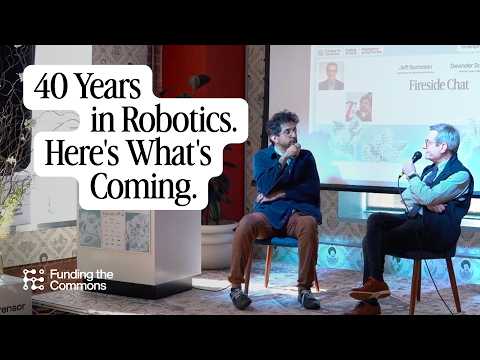
Fireside Chat with Jeff Burnstein (Association for Advancing Automation) and Devinder Sodhi (Frontier Tower, Tess Ventures)

Jeff Burnstein Association for Advancing AutomationDevinder Sodhi Learning Layer Labs

Fireside · 05: Applied AI: Real Deployments · Floor 2 (Funding the Commons)

Description

Jeff Burnstein has spent 40 years at the center of the automation industry — leading A3, the largest trade association for robotics, AI, machine vision, and motion control, and running Automate, the biggest automation trade show in the Americas. This conversation with Devinder Sodhi traces the arc from the factory floor to the agentic economy: how the language of "embodied AI" is reshaping what policymakers fund and what builders prioritize; what actually happens to regular people when the US stalls on industrial AI policy and where industry has to fill the gap; what four decades of human-machine collaboration teach us about the agent economy being built right now; whether the humanoid hype cycle is outrunning the reliability data on wear, workload, and real-world durability; how we bridge the gap between a $400 hobbyist robot and the safety constraints that matter when machines interact with human lives; and — the question this whole room cares about — whether the productivity gains from embodied AI can flow broadly, or whether we're just building a more efficient version of the same concentration. The throughline: robotics learned its lessons about autonomy the hard way, in environments where a bad decision had immediate physical consequences. The software world is racing through the same problems without the same forcing function.

The Comedy of the Wild Commons: How America quietly solved its biggest wicked problem at sea

Jamie Workman Founder/CEO, AquaShares Inc PBC

Floor 14 (Flourishing)

Description

Every Web3 project starts with the same founding nightmare: open access destroys shared resources because no one owns tomorrow. Forty years ago, American fishermen were living that nightmare in real time: racing each other to catch the last fish while regulators piled on rules that only made things worse. Sea Change is the story of how bitter enemies -- commercial fishermen and environmental activists -- designed their way out of it. The key? It wasn't tech marvels or government mandates, but clearly defined rights, equitable allocations, transparent accountability, and a Gulf highliner fisherman named Buddy who became the last guy anyone expected to demand lower limits on his own catch. The lessons travel further than fish.

Life-Aligned AI Research & Development

Tim Hanson CEO & CSO, Springtail AIAdam Goldstein Co-founder and CEO, New Science Lab in Crescent City

Floor 16 (d/acc Lounge)

Description

Discussion on emerging approaches to AI aligned with life and planetary systems.

Your Board Seats Should Include A Drum Throne: Art, Tech, and Disruption

Summer Krinsky

Floor 6 (Arts & Music)

Shadow IT to Shadow Agents: Why Proof-of-Control Matters Now and Lessons from the Open-Source Movement

Brian Behlendorf CTO, OpenWallet Foundation, Open Source Security FoundationTricia Wang CEO, Advanced AI Society; Co-founder, Sudden Compass

Fireside · 04: Open AI Infrastructure · Floor 2 (Funding the Commons)

Description

Every organization that deployed enterprise software in the 2000s eventually discovered its employees had already built their own workarounds — rogue spreadsheets, consumer apps, unauthorized SaaS tools running outside IT entirely. Shadow IT wasn't a failure of policy; it was a signal that official systems weren't meeting real needs. The same thing is happening now with autonomous agents, except faster and with higher stakes. Tricia Wang and Brian Behlendorf bring different but complementary angles. Wang studies the gap between how institutions imagine technology gets adopted and how it actually does — which matters enormously when the agents acting in your organization's name may be impossible to audit after the fact. Behlendorf helped build the open-source infrastructure layer the internet runs on, then spent years at Hyperledger and the Open Source Security Foundation figuring out what makes distributed systems trustworthy and governable. Together they dig into what the open-source movement actually learned about transparency, accountability, and keeping systems from being captured — and what those lessons mean now that the hardest thing to inspect may not be the code, but the agent running it.

Biomarkers of aging - fireside chat with Márton Mészáros

Fireside · Floor 11 (Longevity)

The Future of Work: Collective Intelligence and Global Talent (Fireside Chat)

Jose RiosJean Herelle

Fireside · Floor 9 (AI & Autonomous Systems)

Description

A forward-looking discussion on how decentralized AI networks enable global engineers to contribute to open systems and be compensated based on measurable output. The session contrasts centralized AI consolidation with permissionless intelligence networks, and examines how distributed coordination reshapes incentives, ownership structures, and participation in AI development.

From Multicellularity to Multi-Agent AI: Evolution’s Lessons for Scaling Cooperation

Athena Aktipis Arizona State University, Cooperative Futures Institute

Keynote · 04: Open AI Infrastructure · Floor 2 (Funding the Commons)

Description

In this talk, I explain how cooperation emerges and scales across systems - from cells to societies - and what those lessons can teach us about how to build cooperative multi-agent AI. I begin with my work on cancer as a breakdown of multicellular cooperation, then briefly examine microbial systems like kombucha that function as self-regulating cooperative ecosystems. I also discuss my theoretical work on cooperation in spatially structured populations, including the walk-away model, an agent-based simulation showing how simple behavioral rules can generate positive assortment and support the evolution of cooperation through emergent spatial dynamics. I end by discussing our recent work on building benchmarks for measuring cooperative behavior in AIs, including whether they can build trust, effectively divide labor, and avoid problematic aspects of cooperation like cartel and mafia-like behavior. Evolution has spent billions of years solving the problem of scaling cooperation, and those lessons offer a powerful guide for designing cooperative AI.

IMAGI-NATION Indigenous Systems Thinking Networked Nation State

Talk · Floor 14 (Flourishing)

Description

IMAGI-NATION is a borderless networked state that replaces colonial and patriarchal hierarchies with Indigenous systems of relationality, matriarchal kinship, and "Grandmother Logic." By integrating decentralized technology with ancestral protocols, this model transitions global governance from extractive silos toward a regenerative "Inter-Nation" centered on ecological stewardship and collective care.

How AI Steals Art

Devinder Sodhi Learning Layer Labs

Floor 6 (Arts & Music)

Description

A journey through how models are trained.

Inside the Proof-of-Control Stack: Verifiable Authority as the New Category of Technology in an Agentic AI Economy

Tricia Wang CEO, Advanced AI Society; Co-founder, Sudden CompassPranav Maheshwari Director of Integrations, The Graph / Edge & NodeAnna Kazlauskas CEO & Co-founder, Open Data Labs (Vana Protocol)Shane Mac Co-founder & President, XMTP; Co-founder, Convos, XMTP Convo

Panel · 02: The Intelligence Curse: Who Captures AI Value · Floor 2 (Funding the Commons)

Description

As AI systems become autonomous and act across organizations, enterprises and regulators require more than policy assurances—they require independent provability that moves control from contractual promises to cryptographic proofs. In a multi-cloud world where agents will overwhelmingly outnumber human being, AI cannot scale responsibly without verifiable authority. This panel takes a look at a few Proof-of-Control solutions that enable independently provability that gives humans, communities and organization control over AI infrastructure.

Pandora’s Chatbox: The Generation Growing Up With AI

Eliza Kosoy Researcher, Character AI

Floor 9 (AI & Autonomous Systems)

Description

Pandora’s box is already open: teens are growing up with AI whether we design for it or not. Millions of young people are already studying with it, thinking with it, and sometimes confiding in it. Instead of asking whether teens should interact with AI, this talk asks a harder question: what kinds of AI interactions are actually good for them? Drawing on my PhD research on youth and AI interactions, I explore how AI could support curiosity, learning, and intellectual growth during adolescence. I argue that AI can be profoundly beneficial for teens if we design it intentionally, and present an emerging taxonomy of “good” AI interactions to help guide how these systems are built.

Flow Engineering Workshop (with Author)

Luc Guimberteau Co-founder, Living CodeAndrew Davis

Workshop · Floor 14 (Flourishing)

Description

Free Signed Copy of Book with Ticket Purchase Tired of misalignment, friction, and stalled workflow? Flow Engineering is a practical guide to using value stream mapping techniques to align teams, unlock innovation, and optimize performance. Based on foundations from Value Stream Mapping, cybernetics, and the Toyota Production System, Flow Engineering's lightweight and iterative practices build the value, clarity, and flow required for effective collaboration and collective action. Flow Engineering provides a step-by-step guide for running fast-paced mapping workshops that rapidly build shared understanding. Using five key maps to facilitate collaborative “flow conversations,” show how teams can surface tangled process dependencies, conflicting priorities, and unspoken assumptions that grind progress to a halt. The result? A clear roadmap owned by the people doing the work to accelerate innovation cycles, optimize workflows, and achieve more effective coordination. Applicable across any industry, Flow Engineering's techniques have helped leading organizations improve critical workflows like customer onboarding, product development, and hiring. It's time to stop trying one-size-fits-all frameworks to find value, clarity, and flow to improve culture and performance. Flow Engineering meets your organization where it's at and shows you how to move it where it needs to go. Join us for this exclusive workshop with one of the authors of the book: Andrew Davis

Barry Threw, Gray Area -- Cultural Infrastructure

Barry Threw Executive Director, Gray Area

Floor 6 (Arts & Music)

Why Empathetic AI is the Mother of all Commons

De Kai Professor, HKUST; Distinguished Research Scholar, UC Berkeley ICSI; Independent Director, The Future Society, Empathetic AI Institute / The Future Society

Keynote · 05: Applied AI: Real Deployments · Floor 2 (Funding the Commons)

Description

De Kai pioneered the translation AIs behind Google Translate, Yahoo, and Bing — and his new MIT Press book Raising AI argues that the most dangerous thing we've done isn't build powerful AI, it's failed to parent it. Our cultures are now shaped by 8 billion humans and perhaps 800 billion AIs, and those AIs are attention-seeking, imitative, deeply impressionable — trained on the best and worst of us. In this talk, De Kai makes the case that empathy isn't a soft add-on to AI development, it's the foundational commons infrastructure — the shared value layer without which no amount of governance, mechanism design, or decentralized coordination will hold. We have one shot: this is the last generation of AIs parented primarily by humans. The next will be parented mainly by AIs.

Peter Hirshberg: The Curious Case of Arts and Civic/Economic Innovation

Peter Hirshberg

Floor 6 (Arts & Music)

Neglected Approaches to AI Alignment

Diogo de Lucena Chief Scientist, AE Studio

Floor 9 (AI & Autonomous Systems)

Description

As AI systems grow more capable, the question of whether they will reliably act in humanity's interest becomes one of the most consequential challenges of our time. The alignment field has converged on a handful of dominant approaches while vast swaths of high-potential research go unfunded and unexplored. Drawing on AE Studio's research program built to pursue high-risk, high-reward ideas with outsized impact, this talk explores neglected directions, including self-other overlap training (reducing deceptive behavior by closing the gap between how AI models itself versus others), gradient routing (surgically controlling which capabilities develop where in a model), neuroscience-inspired prosocial AI (drawing on how empathy and cooperation emerge in humans to build AI that is inherently more aligned), and more. It makes the case for why backing unconventional alignment bets may be one of the highest-leverage things the public goods community can do right now.

Thoughts for the Funding the Commons community in 2026

Juan Benet Founder & CEO, Protocol Labs

Keynote · Floor 2 (Funding the Commons)

Description

The world FtC was built for has arrived faster than most expected. Juan offers a brief orientation: where the community stands, what the surge of AI-driven economic and political transformation demands from us, and what kinds of coordination infrastructure actually matter in this moment. Juan Benet is the founder and CEO of Protocol Labs, the R&D lab behind IPFS and Filecoin - two of the foundational protocols of the decentralized web. Juan has spent the last decade building the infrastructure layer for a more open internet. He was also the genesis behind Funding the Commons, recognizing that sustainable public goods funding needed its own coordination infrastructure - and that the people building it needed a place to find each other.

Roundtable Discussion: Are building the Cage or the Rails?

Roundtable · Floor 12 (Ethereum & Decentralized Tech)

Description

AI is reshaping every layer of the technology stack — from infrastructure and middleware to applications and governance. But who owns the intelligence? As foundation models consolidate power in the hands of a few corporations, decentralized technologies offer a counter-narrative: open networks, community-owned compute, verifiable inference, and autonomous agents that answer to protocols instead of shareholders. This roundtable explores where decentralization and AI intersect across the full stack — from bare-metal GPU networks to onchain agent economies to democratic AI governance. The question isn't whether AI and crypto will converge. It's whether that convergence will distribute power or concentrate it further. 1. The Infrastructure Layer — Decentralizing Compute and Data 2. The Model Layer — Open vs. Closed, Owned vs. Shared 3. The Agent Layer — Autonomous Systems on Open Rails 4. The Application Layer — AI-Powered Public Goods and Coordination 5. The Governance Layer — Who Decides How AI Behaves? 6. The Tension — Decentralization vs. AI's Centralizing Gravity

Building a Secure Agentic Future

Illia Polosukhin Co-founder & CEO, NEAR Foundation, NEAR Protocol

Keynote · Floor 2 (Funding the Commons)

Description

Agents are the final operating system, replacing most of our digital actions and commerce with a single interface. Illia discusses how to ensure our agentic future is secure, preserves users' privacy, improves coordination, and remains open & neutral. Illia Polosukhin is Co-Founder of NEAR, on the mission to build User-Owned AI. Before NEAR, Illia worked on AI research at Google and co-authored the landmark paper, "Attention Is All You Need."

Fireside Chat with Illia Polosukhin (NEAR) and Juan Benet (Protocol Labs)

Illia Polosukhin Co-founder & CEO, NEAR Foundation, NEAR ProtocolJuan Benet Founder & CEO, Protocol Labs

Fireside · Floor 2 (Funding the Commons)

Description

For the third consecutive year at Funding the Commons, two of the architects of the open internet sit down to think out loud. They've watched this technology develop from the inside. This conversation is about what AGI demands from humanity: the governance structures, economic models, and coordination infrastructure we need to build before the transition is upon us rather than after.

Fireside chat - Scott Moore, Barry Threw, Peter Hirshberg

Barry Threw Executive Director, Gray AreaPeter Hirshberg

Fireside · Floor 6 (Arts & Music)

How Ben Franklin Solved AI Safety

Sam Stowers AI Product Lead, Artificial Intelligence Underwriting Company

Floor 9 (AI & Autonomous Systems)

Description

How can we make AI systems default-secure without depending on government regulation? In this talk, we'll cover the epidemic of house fires in 1736 Philadelphia, Benjamin Franklin's work on safety standards, and how the combination of standards and insurance can fix bad incentive structures.

A Live Funding Experiment & Closing Words

David Casey CEO, Funding the Commons

Talk · Floor 2 (Funding the Commons)

Description

To close the conference, we're doing something that hasn't been done before. Artizen Fund deployed a new mechanism called the Boost - a time-bound match that turbocharged donations during a quadratic funding round for projects in the Funding the Commons ecosystem. $100k in match funding. Real projects. Real recipients. We'll close the day on stage to walk through how the Boost worked, announce the results live, and hear directly from the projects who received funding. Some of them are in this building right now. This is what coordination infrastructure looks like when it ships. https://artizen.fund/index/mf/funding-the-commons-frontier-fund?season=6&scroll=no

GDC ESPORTS GAMES — STAKENSLAY

Rene Turcios

Other · Floor 7 (Maker Space)

Description

Closing Night @ Makerspace Floor 7 https://luma.com/gdc-esports-games-stakenslay A late-night esports session closing out GDC and Funding the Commons SF 2026. 🎮 FEATURING STAKENSLAY: 1v1 FPS WAGERING & TOURNAMENT 🎮 Think you have top-tier aim? Put your money where your mouse is! Tonight’s main feature is Stakenslay—a fast-paced, 3D first-person shooter where you can challenge other attendees to intense 1v1 matches and wager real money on the outcome. 🏆 Tournament Prizes: 1st Place: $250 2nd Place: $50 3rd Place: $50 💻 Important - Bring Your Own Device (Laptop): For crypto security reasons, you must bring your own laptop to play. Since you will be logging into your own account and managing real money/crypto wallets, using your own device keeps your funds completely secure. (Mobile support might be available by the time of the event, but please bring a laptop just to be safe!) Join us at the PROTO7YPE Makerspace on Floor 7 of Frontier Tower for competitive matches, experimental games, and DJs running throughout the night. After a full week of talks, demos, and hackathons across the city, this is a place for builders, designers, and game developers to actually play. Expect a mix of high-stakes Stakenslay battles, casual tournaments, open stations, and people bringing their own builds. Come compete, spectate, or just hang out with the dev and hacker community.

Recorded talks
36 from this edition

Intelligence at the Frontier: Building for Human Flourishing in the Age of AIIntelligence at the Frontier Hackathon RecapTricia Wang: Pi, Einstein, and the Choice We Face with AIDavid Dao: Can We Govern the Commons at Planetary Scale?Sheila Warren: The Acceleration of DehumanizationAugusto Ardiles Diaz: How Cities Become AI Innovation LabsMatthias Broner: UNICEF's Financial Rails for the Age of AIShady El Damaty: Human Flourishing in the Age of AILiz Barry: Engineering Democratic Systems for the Age of AIJamie Joyce: Scaled Democratic ReasoningSam Klein: Building Libraries Any Agent Can EditJoshua Tan: Incubating Networked Systems and Autonomous OrgsAviv Ovadya: Democratic Infrastructure for the Age of AIAdam Russell: It's the Institutions, StupidAdam Russell & Tom Kalil: What Do We Want AI to Do for Us?Al Smith: Sustainable Funding for Internet Freedom ToolsMichelle Finneran Dennedy: Privacy Is the Heartbeat of HumanityInternet Archive: Public Data for a Public AIEvan Miyazono: Alignment Is Not EnoughPaul Riechers: Understanding AI, Unlocking OptionalityQuentin Feuillade-Montixi: Why AI Needs Its Own LanguageRyan Kidd: Scaling AI Safety and SecurityAshutosh Desai: On the Shoulders of CapitalismWho Owns the Intelligence? Open vs. Closed AIShaw Walters: Open by DefaultCheryl Contee: We Asked for Flying Cars, We Got LLMs InsteadEsben Kran: Superintelligence Companies and Humanity's FutureJeff Burnstein & Devinder Sodhi: Physical AIBrian Behlendorf & Tricia Wang: Shadow IT to Shadow AgentsAthena Aktipis: From Multicellularity to Multi-Agent AIDe Kai: Why Empathetic AI Is the Mother of All CommonsJuan Benet: Thoughts for the FtC Community in 2026Illia Polosukhin: Building a Secure Agentic FutureIllia Polosukhin & Juan Benet: Building the Agentic FutureInside the Proof-of-Control StackA Community Treasury, Allocated by AI Digital Twins: The Simocracy Experiment

Open the full playlist

Full timed schedule, as plain text

← All past events